

Today no day goes by without talking, thinking and being impacted by artificial intelligence (AI). Every aspect of our human lives has been touched by AI in one way or another. The economy, accountability and civic participation are but a few key dimensions that intersect and engage with AI dynamically. Policy, regulation, ethics and integrity, and rules are all key element to analyze AI and its influence on democratic governance. Moreover, while AI may have some useful and valuable elements, the risks are currently at the center of debates regarding AI’s compatibility with democratic governance. Authoritarian regimes and systems are using AI to sustain their power and to suppress rights and freedoms even outside their borders, while democracies have to navigate pluralistic approaches to ensure rights and liberties are protected and develop when using AI and implement strategies to manage risk scenarios. What is driving the current debate and discussions related to AI and democratic governance?
The Potential of AI for Democratic Governance
I recently participated in the 10th edition of the Internet Governance Dialogue (DGI) in Costa Rica, organized by the Country Committee Secretariat. The overarching theme of the dialogue was Artificial Intelligence and Internet Governance. Our panel focused on the protection of data and rights in the era of AI. It was a great opportunity to reflect on linkages and disconnections between democratic governance and AI, as well as the opportunities and threats. As I argued elsewhere, democratic governance is more than holding periodic, open and competitive elections. While freedoms and the right to vote are important ingredients of democratic governance, they are not sufficient to govern democratically or in a pluralistic way. The rule of law as a means to constraint power and discretion, accountability to hold powerholder to account, the effective and efficient delivery of public services in return for tax payments, and protecting, sustaining and expanding rights are other key ingredients of democratic governance.
Democratic governance is a system of rules in which power resides with the people, and decisions are made through transparent, accountable, and participatory processes rather than by autocratic decree. The architecture of democratic governance in any given country offers the space and elasticity for political and policy processes through which government and citizens reach a consensus on a number of “public good” policy areas, such as regulations, human rights, laws, justice, welfare and environmental protection. Today, AI intersects in key areas of democratic governance. For example:
- Enabling Deliberation and Decision Making: Platforms such as Polis is, Remesh, Ethelo, Kialo, and Deliberation io, among others, use AI as a tool or guide to help diverse groups find common ground, scale public discourse, make decisions, and exchange views.
- Information Access and Efficiency: AI can help citizens navigate complex policy proposals, translates languages to lower barriers to participation, and assists fact-checkers to review claims rapidly.
- Transparency and Accountability: As part of internal controls, prevention strategies, and keeping citizens informed, government entities can deploy AI to detect corruption, summarize public comments, and improve the responsiveness of public institutions and trust of them.
Many of these applications are a continuation and expansion of the so-called e-governance and back office tasks, but others are experimental and being tried at both national and local dimensions.
Democratic Governance Risks
While the potential of AI remains dynamic and promising to improve the quality and effectiveness of democratic governance, the current risks highlight AI’s detrimental role in eroding democratic governance. A few examples of how AI can be used to disrupt democratic governance are:
- Alternative Realities: Generative AI tools can produce hyper-realistic deepfakes, fake documents, and automated text, and distort public perception and put the burden of fact checkers. This is not only detrimental during election processes, but also during governance, policy and deliberation processes.
- Planting Seeds of Distrust: Unreal media and AI generated spokespeople and voices can cast doubts in news, journalism, policies, solutions, and the value of holding leaders to account.With the misuse of AI, distrust in democratic processes may grow even further, to the detriment of democratic governance.
- Tech Oligarchy and Concentration of Power: A consequence of unchecked power is holding power through relatively open elections, but political, economic, and social control in the new government is transferred to a small, exclusive and wealthy group of individuals who own and/or are linked to technology platforms and AI tools, and who work to influence policymakers to pass and support self-serving policies and expect protection against legal and financial liability. Democratic governance weakens as citizens have little to no meaningful influence over policy decisions or leadership selection.
- Persuasion and Microtargeting: The use of AI chatbots to influence and sway election results targeting groups and opting to polarize rather than discuss solutions, and potentially influence political violence.
What to Do? Some Policy Approaches
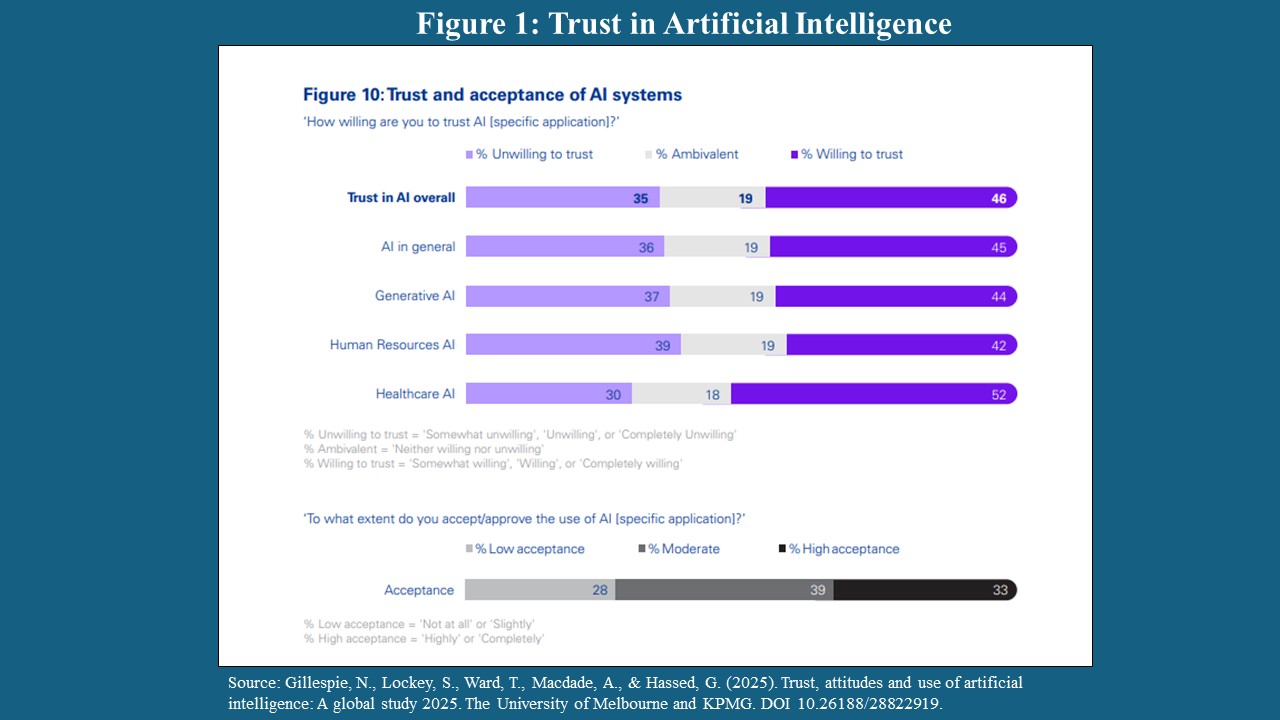
As can be seen in Figure 1, most people seem ambivalent or unwilling to trust AI systems but accept their use. The concern about the safety and security of AI and its impact on people helps explain why a little over half (54%) of people are wary about trusting AI systems. Trust in AI may vary depending on the application of AI, for example in relation to healthcare, reflecting perhaps a perceived direct benefit regarding medical diagnoses and treatments. A Pew Research Center study found that a median of 34% of adults across 25 countries are more concerned than excited about the increased use of AI in daily life. The latest AI Index Report found that globally, trust in governments to regulate AI varies. Among surveyed countries, the United States reported the lowest level of trust in its own government to regulate AI, at 31%. Globally, the EU is trusted more than the United States or China to regulate AI effectively.
There is no blueprint or magic formula to engage with AI from a democratic governance perspective. What is clear is that any approach would have to balance both the potential benefits and the risks. AI can offer powerful tools for improving democratic governance, accountability and transparency, enhancing citizen informed engagement, improving service delivery, and expanding democratic resilience. On the other hand, AI’s ability to manipulate public opinion, infringe upon privacy, and destabilize democratic institutions presents serious challenges.
Governments are experimenting with diverse policy frameworks, ranging from the European Union’s rights-centric AI Act to implementing multi-dimensional policy frameworks (i.e., the State of California). There are proposals from civil society for independent algorithmic audits, clear legal liability for coordinated bot swarms, and civic AI tools built for the public interest. The United Nations (UN) has also taken interest to offer its own guidelines. For example, the Global Digital Compact & Resolution 79/325 adopted as part of the UN’s Pact for the Future created two primary institutional pillars: 1) an Independent International Scientific Panel on AI to provide independent, evidence-based assessments on the capabilities, risks, and scientific realities of rapid AI development; and 2) the Global Dialogue on AI Governance, a recurring international forum for governments, civil society, and the private sector to coordinate policy. Also, the UN produced the Governing AI for Humanity Report with recommendations to bridge the gap between developed and developing nations.
Pope Leo XVI also weighed in, when he issued the AI encyclical, “Magnificent Humanity,” calling for a robust regulation of AI and for its developers to work for the common good rather than profit. The document has an underlying premise: technology is not “a force antagonistic to humanity,” nor is it “inherently evil.” However, “technology is never neutral, because it takes on the characteristics of those who devise, finance, regulate, and use it.”
AI cannot be understood solely as a technological issue. Technological risks and opportunities are part of a wholistic dynamic that often intersect with physical, legal, political, business, psychological, institutional, financial, and pedagogical dimensions. Both opportunities and risks are responding to gaps stem not only from the sophistication of the technology, but also from structural weaknesses within the democratic governance ecosystem itself. Without sustained investment in expertise, stronger engagement with and from technology companies, better-aligned policies, and long-term capacity building, the gap between the scale of AI and the ability to manage it is likely to continue widening. Moreover, the disparity between developed and developing countries in adopting, adapting and/or implementing AI will be a key determinant of opportunities and risks. Ultimately democratic governance is about humans and institutions, and how to use technology and/or AI as a means not as an end in itself.
More work needs to be done on the early design stage of preventive and engagement policies. For example, identifying what is working in the different intersections between AI and democratic governance, from election to policymaking and accountability, or analyzing challenges and opportunities in developed and developing contexts. The resilience of democratic governance institutions matters, not only in the ability to shift and adapt, but also in finding effective institutional solutions and safeguards at all levels of government. Similarly, increased civil society capacity and involvement is key, including skill building, coalition work for cross sectoral work, and global learning and exchanging. With AI bringing simultaneous opportunities and risks to democratic governance, a whole of multi-stakeholder approach is needed, to bring closer, government, the private sector, civil society organizations, and academia to collaborate and device impactful action frameworks and metrics to protect and expand democratic governance with the help of AI. Today the need for democratic governance engineers could not be greater.
*Source of the photo: Pexels, 2026

